Circle Labs V1000 English ver.
Opinion 1
Today will be a bit reminiscing, sentimental, and just as Zbigniew Wodecki liked to return to places where he had already been, we decided that it was worth checking what has been hatching in the meantime, and what is happening with one of the Polish manufacturers, who is becoming more and more recognizable not only in Poland, but also abroad. In short, after a break from testing the A200 integrated, the P300 & M200 separates and an addition in the form of a set with two amplifiers, time has come for the Krakow proposal aimed at vinyl lovers. We are talking about the Circle Labs V1000 phono preamplifier, which hides a few original curiosities inside its chassis, as far as the rumor goes, competes very effectively with much more titled competition. And I will tell you in a moment, how it fared in our listening room.


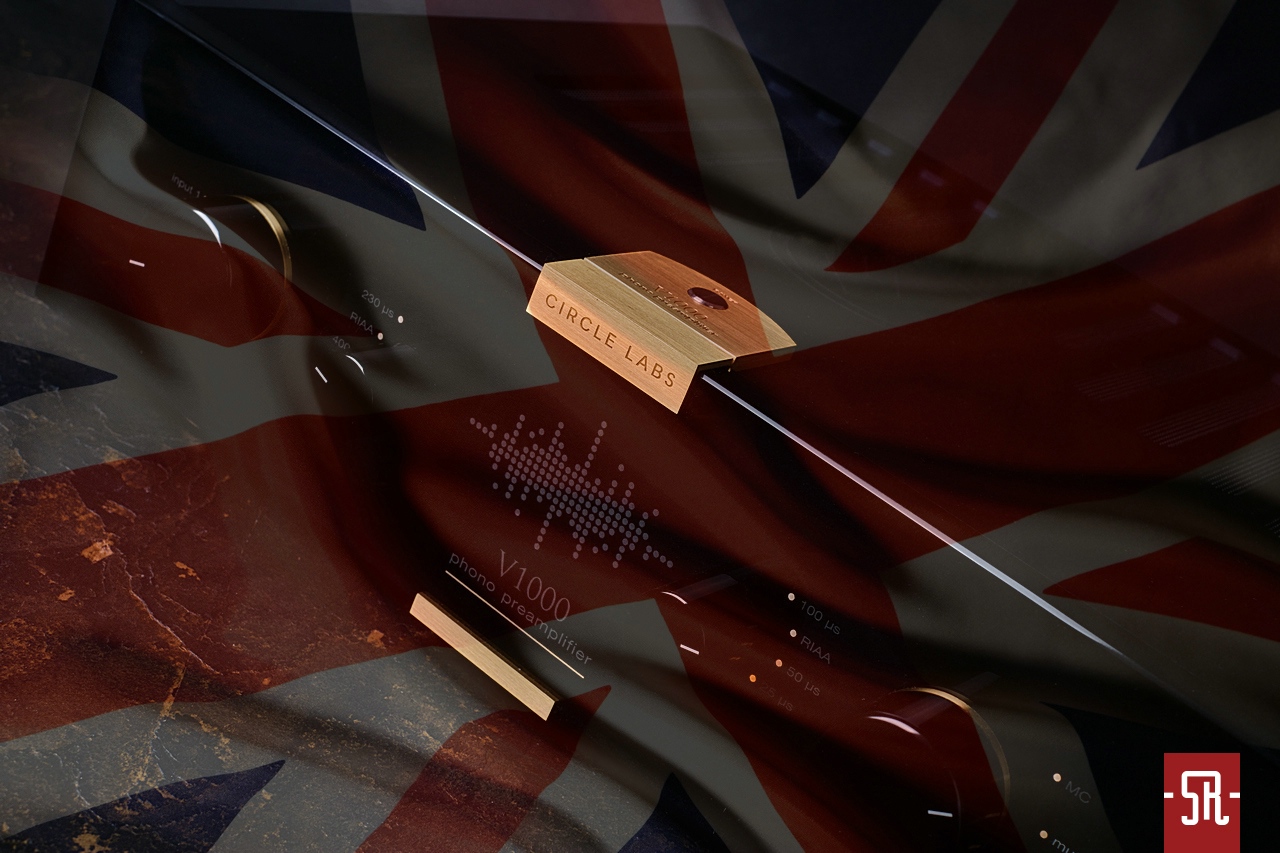
For now, however, let us focus on its, very attractive, appearance, because it, although in line with the looks chosen at the dawn of the brand’s activity, has undergone a delicate transformation due to the strictly specialized function it has to perform. While the integrated and the preamplifier have two knobs on their characteristic black glass fronts, and the amplifier was completely devoid of such attractions, in the V1000 the number of knobs is doubled. To the source and cartridge type selector there is a pair of knobs with a slightly smaller diameter, responsible for selecting the correction curves. Yes, yes. Circle Labs joins the elite group of phonostages (like for example the Air Tight ATE-3011 or Gold Note PH-10) which compliant not only with the modern RIAA standard, but also allowing you to adjust the operating parameters to slightly more exotic / historical (used before 1954) curves. According to tradition, the power switch is integrated in a decorative brass signboard.
The rear panel offers two pairs of RCA inputs and outputs in both RCA and XLR standard. The parameters of the cartridges used (10 – 1000 Ω / 0-320 pF) are set using appropriate microswitches, and the list of available connections is closed by a multi-pin power socket, into which the cable connecting the signal unit with the power supply section residing in a separate, smaller body should be plugged. And here is a pleasant surprise, because while in most cases the power supplies included by the competition (vide VdH) are not the most pretty, the one included with the V1000 can be safely placed in plain sight, because, to put it bluntly, although it does not have a glass pane on the front, it is as beautiful as its full-size siblings.
From the technical point of view, we are dealing here with a dual mono topology based on four e88cc / 6922 tubes. From the power supply to the signal unit, the alternating voltage is supplied and rectified only „on site”. To make things even more interesting, before the MC amplification section, the step-up transformers are not some widely available units, but proprietary transformer, manufactured with a double nanocrystalline core and simultaneously wound secondary and primary windings.
Taking into account that so far I had only heard the V1000 in quite random circumstances during the past Munich High End, I approached its tests with a completely calm head. After all, exhibitions are for watching, not listening, and the composition of more or less random setups is usually a result of the offering of a given distributor / dependence of this distribution nature, etc. rather than an uncompromising pursuit of the highest possible sound quality. The only thing I could expect was above-average musicality and a slight warmth, resulting from experience with previous editorial performances, because these were the qualities that charmed us his older siblings. As it turned out, however, I also had to revise these expectations quite seriously, because the Krzysztofs (Wilczyński and Lichoń), who were behind the eponymous construction, in order to slightly slow down the increase in the sugar content in the „monotheistic” setups owned by the lion’s share of their clientele, decided to put a little more emphasis on linearity and perhaps not so much analyticities, as emotional balance and neutrality. As a result, the tubes applied in the V1000’s bowels play only a purely technical role of amplification, and not elements intended to leave any mark or signature on the final sound. As you can easily guess, this way we get a very reliable sound, far from trying to attract the listener’s attention, closer to exemplary transparency than the charm and magic attributed to tubes. This does not mean that the music is devoid of any emotion or distant, but the device discreetly disappears into the track and allows the reproduced music to sound exactly as it was recorded. Therefore, we are dealing with a faithful reproduction and not an author’s interpretation of the amplified signals, so Metallica’s „Hardwired… Self-Destruct” with the Circle in the sound path will be far from sweet and smooth, and „Vägen” by Tingvall Trio will be far from exaggerated warmth. However, it is enough to reach for „Minione” by Anna Maria Jopek and Gonzalo Rubacalba to let yourself be carried away by the aesthetics of pre-war hits pulsating with Latin rhythms. There is charming elegance, cheerful melancholy and a certain touch of subliminal patina. The above repertoire change also shows us how different the sound of the piano can be, which in the Tingvall Trio can even oscillate around the glassiness, to operate under the fingers of the Rubalcaba in much lower registers and with a meatier consistency. So we have irrefutable proof that the Polish phonostage does not even try to average and unify anything, but keeps its finger on the pulse all the time and, like a chameleon, adapts to the atmosphere and aesthetics of the recordings coming to its inputs. I observed a similar differentiation when attaching to it, out of pure curiosity, apart from my trusty Denon DP-3000NE with the DL-103R cartridge, the Triangle Lunar 3 with the Goldring 1042, representing the MM camp, suspended on the light Pro-Ject carbon arm. And here the differences were clearly visible, because the English stylus clearly focused on a deep and juicy sound compared to the Denon, focused on rock drive and timing. This is a kind of hint for users who either have it, or intend to add a second tonearm / turntable to their resident set, that with the help of the V1000 the change of the source will be limited only to turning one or two (when changing the type of cartridge) knobs, so all the acrobatics with reconnecting the wiring will be eliminated, not to mention the laborious replacement of the cartridge and its calibration. It is also worth experimenting with the outputs, because as I managed to mention in the description part of its construction, Circle Labs, apart from RCA, also has XLRs and at least in my case it was able to show a slightly more open and vital sound when using them.
It is also worth noting that Circle Labs operates with dynamics on both a micro and macro scale very carefully, so they are able to convey both the discreet work of the rhythm section in small jazz bands, and the momentum of stadium live rock dinosaurs („Live At River Plate” by AC/DC). And here I will immediately allow myself to make an observation, because the bass offered by the V1000 is usually perfectly kept in check and kicks rather than rumbles, so listeners accustomed to its slight loosening, or even insubordination, may initially have the impression of a certain economy. However, this is only a consequence of one’s own habits, not an objective assessment of the existing reality.
As you can see, the Circle Labs V1000 on the one hand maintains full compliance with the company’s DNA in terms of design, and on the other hand – in terms of sound it indisputably evolves towards greater transparency and linearity of presentation. Therefore, when deciding to verify its sonic qualities in my own system, I recommend not to be particularly influenced by its tube guts, but to focus on the sound without the above burdens. Thanks to this, it will be easier for you to get over the fact that it is simply an extremely truthful device that does exactly what it was designed for, leaving the interpretation of the reproduced music to the listeners. That is, you. Nothing more and nothing less.
Marcin Olszewski
System used in this test:
– CD/DAC: Vitus SCD-025mkII + 2 x Quantum Science Audio (QSA) Blue Fuse
– Network player: Lumïn U2 Mini + Farad Super3 + Omicron Magic Dream Classic; I-O Data Soundgenic HDL-RA4TB
– Turntable: Denon DP-3000NE + Denon DL-103R
– Phonostage: Tellurium Q Iridium MM/MC Phono Pre Amp
– Digital source selector: Audio Authority 1177
– Integrated amplifier: Vitus Audio RI-101 MkII + Quantum Science Audio (QSA) Violet fuse
– Loudspeakers: AudioSolutions Figaro L2 + Solid Tech Feet of Balance + Zu Audio jumpers
– IC RCA: Furutech FA-13S; phono NEO d+ RCA Class B Stereo + Ground (1m)
– IC XLR: Organic Audio; Vermöuth Audio Reference; Furutech DAS-4.1
– Digital IC: Fadel art DigiLitz; Harmonic Technology Cyberlink Copper; Apogee Wyde Eye; Monster Cable Interlink LightSpeed 200
– USB cables: Wireworld Starlight; Vermöuth Audio Reference USB; ZenSati Zorro
– Speaker cables: WK Audio TheRay Speakers + SHUBI Custom Acoustic Stands MMS-1
– Power cables: Furutech FP-3TS762 / FI-28R / FI-E38R; Organic Audio Power + Furutech CF-080 Damping Ring; Acoustic Zen Gargantua II; Furutech Nanoflux Power NCF; Esprit Audio Alpha
– Power distribution board: Furutech e-TP60ER + Furutech FP-3TS762 / Fi-50 NCF(R) /FI-50M NCF(R)
– Wall power socket: Furutech FT-SWS(R)
– Switch: Quantum Science Audio (QSA) Red + Silent Angel S28 + Farad Super6 + Farad DC Level 2 copper cable
– Ethernet cables: In-akustik CAT6 Premium II; Audiomica Laboratory Anort Consequence, Artoc Ultra Reference, Arago Excellence; Furutech LAN-8 NCF; Next Level Tech NxLT Lan Flame
– Anti-vibration platform: Franc Audio Accessories Wood Block Slim Platform
– Table: Solid Tech Radius Duo 3
– Acoustic panels: Vicoustic Flat Panels VMT
Opinion 2
Probably most of you know, that the eponymous brand, despite its relatively short experience on the commercial market – of course, like most of the world’s entities of this type, it evolved from DIY – has already managed to consume a large piece of the domestic audio segment. And if so, you also know that at the moment its portfolio only includes designs from the signal amplification department. Of course, we tested all the devices personally. It was the A200 integrated amplifier and a set of separates based on the P300 line preamplifier and the M200 power amplifier in stereo mode or two in mono mode. And when it seemed that the gentlemen stationed in Lesser Poland under the sign of a Circle could easily just cut coupons from what they already made, they did not rest on their laurels and offered their own phonostage to a wide range of turntable lovers. Yes, yes, if someone has devices of this brand and uses a turntable in their set, now they will be able to complete a company „tower”, something that was once the dream of every adept of our hobby. I have this experience with another manufacturer myself and I know, that despite the fact that the appearance does not sound, in the long run the visual consistency of the entire audio system cannot be overestimated. However, I assure you, it would be wrong to think that today’s design was created only as a nice gadget to complement the company’s setup. According to the manufacturer, this is a design that easily competes with the biggest names in the world, and the proof of this is to be the offer us to carry out another test. In this way, after a few meetings with the amplification section, I invite you to a few paragraphs about the latest child of the Krakow brand Circle Labs in the form of the V1000 phono preamplifier.


Trying to describe the appearance of our hero. I will not be particularly revealing, because as I wrote, it is a deliberate duplication of the idea for the rest of Circle Labs’ offer. Of course, we are dealing with a perfectly designed rectangular box with a blackened glass front. The latter, in addition to the two medium-sized knobs oriented on the outer edges and in a slightly narrower arrangement of slightly smaller knobs that allow you to make selected settings for the cartridge used, for design purposes on the lower and upper edges there are two additional accents finished in gold. And this is not the end of cool treatments to a good visual perception of the design, because the rest of the case, especially its upper part, also follow the trail of an interesting appearance. And it was implemented by extending the golden island from the front to the upper panel, which is the platform for the device’s power switch, embossing a large brand logo in the center of the device’s top cover and surrounding it at the back and sides with various lengths of cut holes ventilating the bowels of the structure. Perhaps words do not convey it well, but I assure you, the project looks great in person. When it comes to technical information, a very important, and I think maybe the most important for many of you, information is, that electron tubes are used in its electrical circuits and at the signal input uses a proprietary version of a step-up transformer. Naturally, being a design aspiring to be a representative of the High End, the V1000 offers the buyer the possibility of operating two tonearms and two types of cartridges, i.e. MM and MC, which is clearly proven by the rich equipment of the rear connection panel. Finally, for technical purists, there is one more important issue, and that is the separation of the power supply of our hero into a separate black box, connected with a dedicated cable with the signal section. The chassis of the PSU is also bearing a gold logo. As you can see, the idea is very well thought out from the visual side. But is it similar in terms of sound? I will write a few sentences about this in the next part of the test.
Before we move on to the description of our hero’s sonic capabilities, some important information about the general aspects of Circle Labs electronics must be given. Do not worry, this is not any watering down of the text or saving the situation, but outlining the context that guided the designers in determining the final style of the 1000’s sound. Well, the amplification section of the Circle Labs in each configuration, depending on how many components are used, focuses on more or less controlled energy and juiciness of the system’s sound. It is always a search for beauty in music with nicely presented curves, which on the one hand is very desirable, but on the other hand requires attention in the configuration of the rest of the system. However, before a shiver of concern goes through you, I recommend you to stay calm, because despite my personal contact with several configurations of this brand, I have never encountered any sound problem of such a conglomerate. They simply sound essential, but they are so power-efficient that you really have to make an effort to waste their interestingly implemented approach to the world of music. So how did the phonostage fare against this background? Well in a slight, and I mean, slight opposition to that. The sound focused on a higher speed of signal rise and at the same time less roundness, and thus a slight hardening and less blurring in the time domain of the sound of virtual entities. Is it bad? For me, quite the opposite, because an additional dose of the roundness described at the very beginning, could cause the effect of losing the clear location of virtual entities interpreted differently in terms of energy and sharpness. And so, as feedback from a good move by the designers, we gain a clearer focus in the drawing of individual musicians, which, together with better sound control, allows us to hear more virtuosity in their creation of the world of music, and what is very important to me, this happens without loss of resolution, which allows us to raise the level of listening volume to the limits of pleasant hearing endurance, which, as you probably remember, I like very much. To sum up, plugging the tested phono preamplifier into my system resulted in the drive of the stage events being watched much more closely, which is very important to me, and this was interestingly embellished with the aftertaste of the glass tubes used in the circuits. And it is interesting because, apart from introducing a nice dose of plasticity into the sound, I did not feel the impression of its excessive vibrating and overheating, which would certainly destroy the probable plan I mentioned to ensure the synergy of the full set of Krakow designs. And to be honest, when I received information during a phone conversation that I would need to tackle a vacuum tube construction, I was almost sure that in some cases, like in rock shows, this could be a problem, but reality showed a completely different side of such a solution. The tubes did not impose even the slightest, pleasant, but still overheating of the presentation; but without any loss in the speed of signal rise, they skillfully colored it, which in my opinion fits perfectly into the idea of treating yourself to a company set, including all items of amplification.
Bringing you a little closer to the effect of the Circle Labs V1000 on the basis of the albums you listen to, the first one to talk about can be the one you can easily see in the photos, the latest album by Joe Lovano with our jazz band of Marcin Wasilewski called „Homage”. The material has several twists in terms of speed and very often we are dealing with a solid dose of energy changing in the domain of time, which, thanks to the specificity of signal processing by the Polish phonostage, is very well differentiated in terms of quantity. However, this is not the only nice feedback from his application, because when the solo performances came to the fore, the aforementioned keeping an eye on the rhythm and the necessary aggressiveness of the attack did not in the least interfere with showing of not only the finesse of the artists’ work, but also the phenomenal sounding of all kinds of instruments. Of course, after the correction introduced by today’s hero compared to the tested amplifiers with a slightly shorter suspension time in the ether and with a less juicy impulse, but do not worry, in the name of perfect tuning of the system, everything came out very well.
When it comes to harder repertoire, this role was played by my favorite album – „Back in Black” by AC/DC group. This time everything was in its place. I got appropriately accentuated aggression, speed and punch together with a very well heard style of plasticizing the whole by the set of electron tubes used. And if the latter was not enough for someone, the company’s solution of several degrees of adjusting the device to the required sound of the phono cartridge used allowed to reduce or increase both the speed and juiciness of the presentation. Due to the fact that the sound signature of the system was changed a bit more than I would have expected, I personally only tried to use a different load level, i.e. instead of 100 I set 200 Ohm, which resulted in an increase in the body, and in fact an injection of sonorous juiciness, because compared to my everyday configuration, the factory setting of the value in the V1000 was too economical in aspects that were important to me, not allowing me to get to the heart of the music. But this is what these types of opportunities are for, to use them consciously without looking at political correctness. I did so and the team from my youth once again performed very well.
How will I encourage you to try out the Polish Circle Labs V1000 phonostage tested in this giveaway? Firstly, thanks to the possibility of connecting two cartridges, it offers multifunctionality sought by many. Secondly, the multitude of adjustments theoretically affecting only the MM cartridges, but also perfectly audible in the MC version, make it possible to perfectly match the sound of the system that interests us. And thirdly, even with the recommended „factory” settings, what it offers, thanks to the skillful integration of electron tubes into electrical circuits, is an excellent sound offer even for the most demanding music lovers. On the one hand, we get a suitably fast and aggressive sound, and on the other hand, a sound marked by unobtrusive tube plasticity. In a word, the Krakow phono preamplifier offers us music with a capital „M” at a very high level of quality. This is a really great proposition, which when looking for this type of device, should not be underestimated, even when confronted with the world’s biggest names.
Jacek Pazio
System used in this test:
Source:
– CD Player/DAC: Gryphon Ethos
– streamer: Lumin U2 Mini + switch Quantum Science Audio (QSA) Red-Silver
– Preamplifier: Gryphon Audio Pandora
– Power amplifier: Gryphon Audio Apex Stereo
– Loudspeakers: Gauder Akustik Berlina RC-11 Black Edition
– Speaker cables: Furutech Nanoflux-NCF Speaker Cable
IC RCA: Hijiri Million „Kiwami”, Vermouth Audio Reference
IC XLR: Tellurium Q Silver Diamond, Hijiri Milion „Kiwami”, Furutech DAS-4.1
Digital IC: Hijiri HDG-X Milion
Ethernet cable: NxLT LAN FLAME
USB cable: ZenSati Silenzio
Power cables: Hijiri Takumi Maestro, Furutech Project-V1, Furutech NanoFlux NCF, Furutech DPS-4.1 + FI-E50 NCF(R)/ FI-50(R), Hijiri Nagomi, Vermouth Audio Reference Power Cord, Acrolink 8N-PC8100 Performante, Synergistic Research Galileo SX AC
– Table: BASE AUDIO 2
Accessories: Quantum Science Audio Red fuse; QSA Silver fuse; Synergistic Research Orange fuse; antivibration platform by SOLID TECH; Harmonix AC Enacom Improved for 100-240V
– Power distribution board: POWER BASE HIGH END, Furutech NCF Power Vault-E
– Acoustic treatments by Artnovion
Analog stage:
– Drive: Clearaudio Concept
– Cartridge: Dynavector DV20X2H
– Phonostage: Sensor 2 mk II
– Eccentricity Detection Stabilizer: DS Audio ES-001
– Tape recorder: Studer A80
Manufacturer: Circle Labs
Price: 43 900 PLN
Specifications
Reinforcement: MC 65/70dB MM 45
Inputs: 2x RCA
Insole load adjustment: 10-1000 Ω. 0-320 pF independent for each input
Outputs: RCA, XLR (balanced)
Ranges of correction curves: 230, 318(riaa); 400, 630(μs); 100, 75(riaa); 50, 25(μs)
Power cord length: 1,2 m
Lamps: 4 x e88cc / 6922
Dimensions (H x W x D): 130 x 430 x 365 mm (Power Supply: 83 x 98 x 210 mm)
Weight: 9.5 kg (preamplifier), 2.8 kg (power supply)
Fuse: T400mA delayed 5x20mm

